


Back to Black at 20: The hidden story behind the iconic cover of Amy Winehouse’s final album
Back to Black at 20: The hidden story behind the iconic cover of Amy Winehouse’s final album

Lydia Spencer-ElliottSat, October 24, 2026 at 5:00 AM UTC
0

To label a release one of the greatest albums of the 21st century is, generally, a hyperbolic accolade. Not in the case of Back to Black.
The bluntly beautiful 11-track masterpiece, with its jangling Sixties melodies, catapulted Amy Winehouse into the mainstream and elevated the 23-year-old to heights of the artists who’d inspired her: Prince began performing “Love Is a Losing Game” on stage. Ronnie Spector covered the album’s title track live alongside The Ronettes’ hits. It was the bestselling album of the year – and won Amy five Grammy awards in one night. “I am so proud of this album,” she responded, quietly shell-shocked after her historic sweep. “I put my heart and soul into it.”

Amy Winehouse on Back to Black: ‘I put my heart and soul into it’ (Getty)
Wander through Amy’s home borough of Camden on the record’s 20th anniversary and the singer is everywhere; remembered in smiling images taken for Back to Black, and her first album Frank, installed in an open-air exhibition above benches on Granary Square and King’s Boulevard. Among recent visitors is the star’s first stylist, Lou Wood, who took Amy shopping at Selfridges for many of her early photoshoots. “One day she turned up in a massive pair of high heels and hot pants, carrying a guitar. We were walking for five hours,” she says, laughing. “She wasn't a manufactured artist. She had her own mind definitely, and her own style.”
Hilariously funny and down to earth, Amy was a dream to go shopping with. “She liked retro polo shirts, bits of denim, pedal pushers and she used to personify all the clothes,” says Wood. “She’d be like, ‘I don’t like him. I like him.’” All the selected items would then get flung into piles on Amy’s bed, from which they’d cobble together looks for her second album’s promo shots. Any designer items were begged and borrowed from Wood’s contacts. “You had to go cap in hand,” she says. “Amy’s first album was a success, but she wasn’t a household name.“
One such borrowed dress, by Thai designer Disaya Sorakraikitikul, was worn in the eventual Back to Black cover shot – and auctioned for £43,200 (quadruple its estimated price) for charity in 2011. Accessories, though, were done “on the cheap”: A red belt from Topshop, Amy’s own necklaces, plus heaps of “gold and fake” bling from Shepherd’s Bush Market.
Wood had no clue about the success Amy would go on to have when she played Back to Black in her car, blown away by its brilliance before its official release. “We can’t tell the future,” she says. “You do the job that you’re employed to do. You’ve got no idea.”
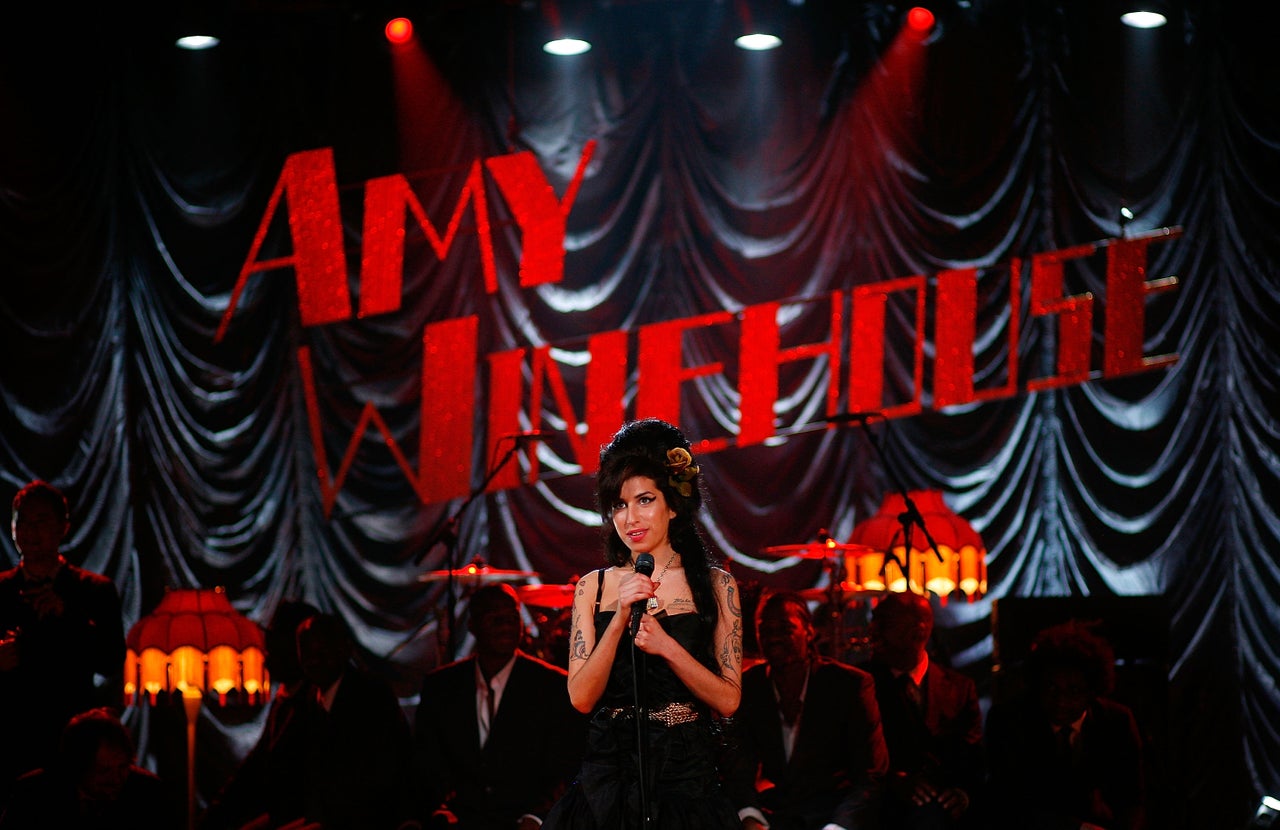
Winehouse on the night ‘Back to Black’ won five Grammys (Getty)
At a time when designers were dragging their feet over lending Amy apparel, photographer Mischa Richter leapt at the chance to work with her when propositioned by Island Records. He’d seen Amy live at a jazz lounge charity gig at The Serpentine, where she was starstruck by Missy Elliot in the front row. “She just kept saying, ‘I can’t believe that you’re here,” he says. “She was adorable. Such an incredible voice. I was blown away.”
Advertisement
On the day of the shoot, Amy was hours late. She’d been at one of her best friend’s weddings the night before and hadn’t been to bed. She wanted the day to be done and was self-conscious in front of the camera, asking Richter whether her friend could stand near the lens with her head facing her to put her at ease. “I said, ‘absolutely not. No way. I can’t work like that,’” he says. “So, we talked for a while, and then she was cool.”
Once the shoot relocated from a bar on Portobello Road to Richter’s home in Kensal Rise alongside the photographer’s young children, Amy relaxed. There wasn’t a big team. There were no studio lights, just the blind-free windows. Naturally, they gravitated towards a room where Richter stored negatives and contact sheets. He took the last shot of the day there, in front of a cupboard that had blackboard paint on its sliding doors, which was selected for the Back to Black cover. “That was serendipitous,” he says of the choice. “We hadn’t had any conversation about the name.”
That day was the last time Richter ever saw Amy. “I see that photo now and I just feel sad,” he says, retrospectively. “I didn’t pick it for the cover. The label did. I think it really shows that she was vulnerable. When I met her in her apartment, then at the photoshoot, you could feel her excitement about what she’d just made; what she’d achieved as an artist before all the b******t that basically killed her. Personally, selfishly, I’m sort of glad that I wasn’t privy to any of that stuff... It swallowed her up.”
After the release of Back to Black, Wood styled Amy for the “Rehab” music video and other gigs and TV appearances. She stopped midway through promotion for the album, after the “You Know I’m No Good” video, where the singer is seen drinking whisky, arguing with a man, and crying on the bathroom floor. “Things had become quite difficult for her,” she says. “It was starting to feel quite uncomfortable for me.”

‘She was vulnerable’: Winehouse died from alcohol poisoning in 2011 (PA)
Today, as the world prepares to celebrate 20 years of Back to Black with a big BBC anniversary concert at Camden’s Roundhouse, Wood still struggles to listen to Amy’s music or see her as any form of entertainment. “Even if I’m out at the pub, I go outside and have a cigarette because I find it difficult,” she says. “Amy wasn’t an icon to me. She was a human being, a young woman, someone with huge talent, who tragically died.”
More than the musician, Wood lost a warmhearted colleague and friend. A deeply compassionate person, who’d invite friends round to her flat and make them all chicken soup. Wood’s main memory of the Back to Black shoot day isn’t the outfits, the artistic difference, or the images – but that her two-year-old son had been in casualty with a high temperature.
“Amy had met my son and was going ‘Oh, can I hold him? Can I hold him? Oh my God, he’s so lovely. Can I babysit?’” she says. “She loved children. So, when I turned up to the shoot after being in hospital all morning, she was like, ‘Why are you here? Why aren’t you at home looking after your baby?’ She was more concerned about him than herself or the photoshoot. She was lovely, caring. Those are the memories I have of her.”
Source: “AOL Entertainment”
