


One of Earth’s Deadliest Supervolcanoes Is Hiding in America—What If It Finally Blew Its Top?
One of Earth’s Deadliest Supervolcanoes Is Hiding in America—What If It Finally Blew Its Top?

Darren OrfTue, September 29, 2026 at 7:40 PM UTC
39
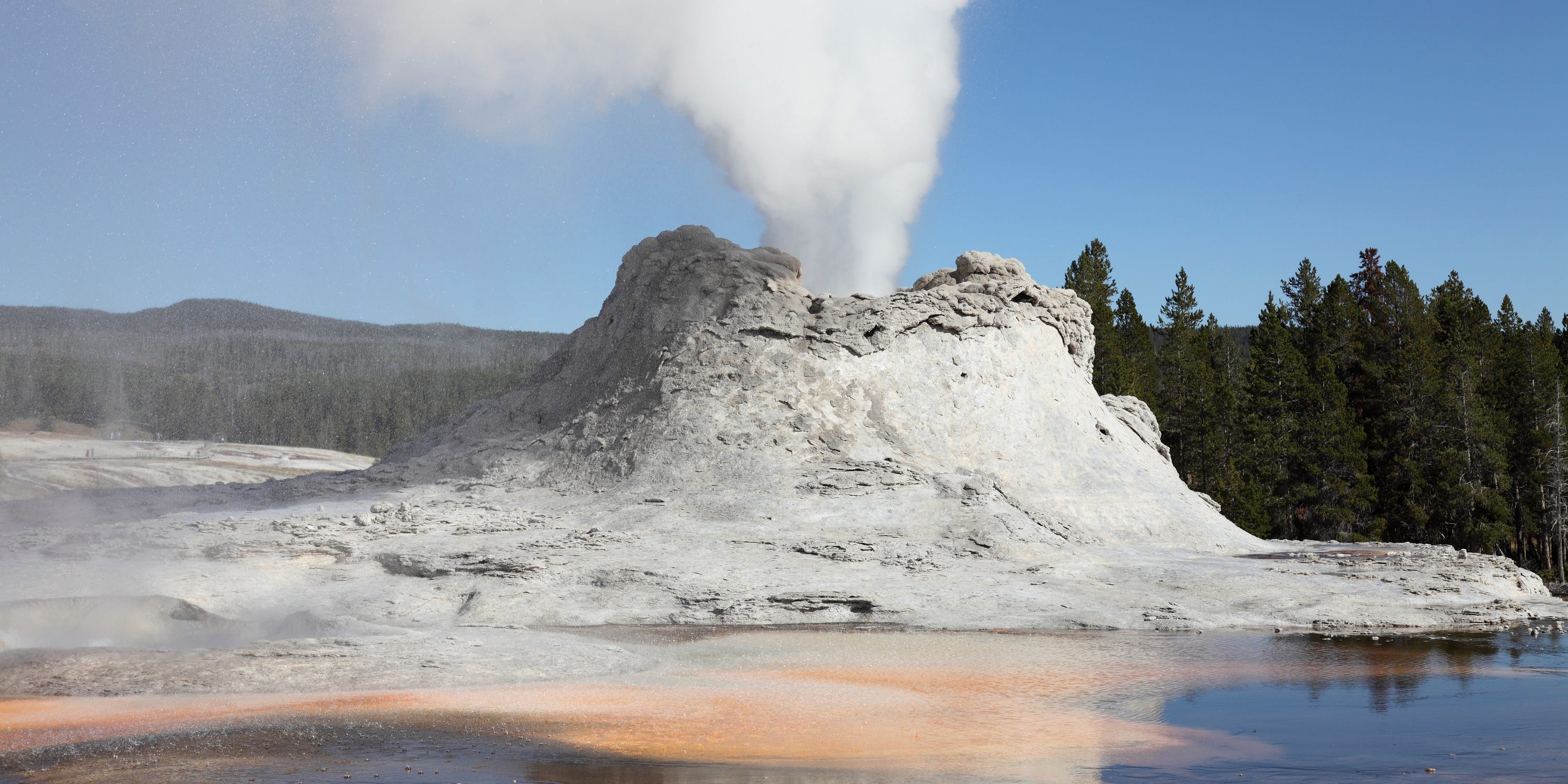
What If the Yellowstone Supervolcano Erupted?Stocktrek Images/Richard Roscoe - Getty Images
Here’s what you’ll learn when you read this story:
Some two dozen or so supervolcanoes dot the planet, and one the most dangerous lies in the heart of North America.
If the Yellowstone supervolcano erupted, hundreds of cubic miles of ash, rock, and lava would devastate the region and cause a global cooling period.
Experts think that humanity would survive the experience, but hundreds of millions could die from indirect effects of the eruption.
Today, Earth is home to an estimated 1,500 volcanoes, ranging in age from Italy’s 500,000-year-old Mount Etna to central Mexico’s Parícutin, which was born in a cornfield in 1943. But only a few of those qualify as “supervolcanoes.” Those impressive volcanic complexes achieve their rarified status based on sheer explosive potential—the ability to spew at least 1,000 cubic kilometers (240 cubic miles) of ash, rock, and lava in a single event, triggering a Level 8 (the highest level) on the Volcanic Explosivity Index (VEI). To put that into perspective, the May 1980 Mount St. Helens eruption released only 0.25 cubic kilometers of material.
While some continents have no supervolcanoes at all, the U.S. is home to three: Long Valley Caldera in eastern California, the Valles Caldera in northern New Mexico, and the most famous (and the most dangerous) of them all, Yellowstone. In the 21st century, the caldera is one of the U.S.’s most cherished National Parks, and its last eruption occurred long before humans even populated the continent. Recently the USGS reported that Yellowstone’s rhyolite magma reservoir is only five to 15 percent molten, making a forthcoming eruption unlikely, but what if humanity hit a particularly devastating bit of bad luck? If this slumbering giant ever decided to wake up, would humanity face impending extinction or could we somehow survive the catastrophe?
Over the past 2.1 million years, Yellowstone has erupted three times, each with devastating results. Some 640,000 years ago, the volcanic system unleashed 240 cubic miles of material while 1.3 million years ago it blew only one-third of that. However, 2.1 million years ago the Earth experienced an immense cataclysm as Yellowstone gushed some 588 cubic miles of ash and lava over a relatively short geological period. While no Homo sapiens were around to witness this incredible eruption, our ancient ancestors did live through the Toba supervolcano explosion 74,000 years ago—a global catastrophe that some scientists theorize nearly wiped out the human race.
But a lot has changed since the late Pleistocene. For one, there are a lot more humans, and secondly, if Yellowstone erupted, we’d have plenty of warning. In a new piece for The Conversation, scientists from University College London and Coventry University laid out a plausible scenario of what would happen if Yellowstone decided to blow. Yellowstone’s immense complexity and ability to produce earthquakes and steam explosions (in addition to volcanic eruptions) make it one of the most heavily monitored volcanic complexes on the planet. As with other major volcanic events such as the Mount St. Helens eruption, experts at the United States Geological Survey (USGS), along with seismologists from universities around the continent, would detect traces of an impending eruption weeks before the main event. And that forewarning would be critical to saving thousands of human lives.
Advertisement
First, small earthquake swarms below the caldera would migrate toward the surface, and as the movement continued, satellites would likely spot accelerating uplift—a tell-tale sign that magma was forcing its way into the crust. Such uplift doesn’t always lead to an eruption—one such uplift event stalled out in 2013-2014)—but if the swelling continued, scientists’ confidence in an impending eruption would grow with each passing day.
International cooperation and the step-by-step process laid out in the Yellowstone Volcano Observatory’s response plan would hopefully keep the death toll from the initial eruption low. But as history has shown, some people would likely stay behind and face the unfortunate consequences. Then the real work would begin as ash descended on the world. Some cities in the U.S. might be buried under several feet of material, and damp ash would short-circuit substations and cause widespread power outages. All the modern conveniences we rely on would cease to function.
As thousands of cubic kilometers of ash pumped into the sky, the world would face a global cooling period of roughly 1.5 degrees Celsius due to increased levels of reflective sulfur dioxide aerosols in the atmosphere. The loss of crops in the U.S. and Canada would send food prices skyrocketing, and access to freshwater would become a top priority. Some ten years after the eruption, the authors argue that hundreds of millions of people might die indirectly, along with possibly more than a billion premature deaths from the massive pollution event that would ensue.
Humanity would survive the catastrophe. But as with many other volcanic eruptions in history, it would be forever changed.
You Might Also Like
20 Cars That Were Massively Improved by a Redesign
Going on Vacation? These Appliances Need to Be Unplugged Before You Leave the House
Roborock Reigns Supreme for Robot Vacuums, but We Also Loved These Other Models
Source: “AOL Breaking”
