


Trump Just Made An Obscure Pentagon Office Bigger Than The Marine Corps. Here Are 5 Stocks For This $1.5 Trillion Defense Opportunity
Trump Just Made An Obscure Pentagon Office Bigger Than The Marine Corps. Here Are 5 Stocks For This $1.5 Trillion Defense Opportunity

Danielle Liverance Tue, July 7, 2026 at 8:57 PM UTC
0
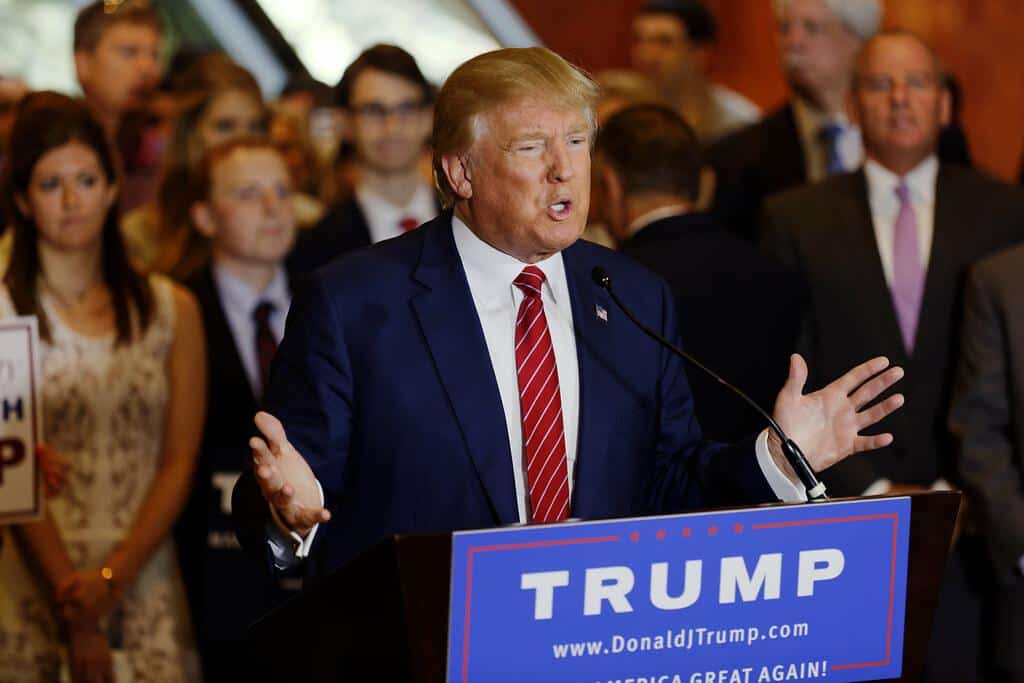
Donald Trump Signs The Pledge by Michael Vadon / BY-SA 2.0 (https://creativecommons.org/licenses/by-sa/2.0/)Quick Read -
DAWG's budget surged 24,000% to $54.6 billion, a figure that exceeds the entire Marine Corps budget, making KTOS and AVAV the most direct pure-plays on autonomous warfare spending.
Against SPY's 10% year-to-date gain, KTOS and AVAV have each fallen nearly 28%, creating a widening valuation gap versus accelerating defense fundamentals.
Trump's $1.5 trillion FY2027 defense request, which represents the largest post-WWII year-over-year increase, faces real passage risk, with Graham and McConnell already pushing back on the reconciliation mechanism.
Act now: the analyst who called NVIDIA in 2010 just named his top 10 AI stocks — and Northrop Grumman didn't make the cut. Grab the names FREE today.
Buried inside President Trump's Fiscal Year 2027 defense budget request sits a line item that dwarfs almost every other increase in the document. The Defense Autonomous Warfare Group (DAWG), a Pentagon office that stood up quietly late last year with an initial budget of roughly $225 to $226 million, is slated to receive $54.6 billion in FY2027. That works out to a roughly 24,000% year-over-year increase, or approximately 243x its prior year budget. The DAWG allocation now exceeds the entire Marine Corps budget request of $52.8 billion and represents nearly 15% of the entire $350 billion reconciliation package. Most investors have never heard of the program.
What DAWG Actually Is
The Defense Autonomous Warfare Group is a newly created Pentagon organization designed to unify all US military drone and autonomous weapons programs under a single command structure. It absorbs and supersedes the Biden-era Replicator initiative, which aimed to field hundreds of thousands of one-way attack drones but ran into supply chain bottlenecks. Internal documents reportedly indicate intent to eventually elevate DAWG into a unified combatant command, effectively making it a new branch of the US military. Crucially, most of the $54.6 billion is directed toward research and development. This is a technology race.
Act now: the analyst who called NVIDIA in 2010 just named his top 10 AI stocks — and Northrop Grumman didn't make the cut. Grab the names FREE today.
Total drone and counter-drone spending in the FY2027 request reaches approximately $74 to $75 billion, tripling FY2026 spending levels. The Department of War's own overview earmarks $53.6 billion for autonomous systems procurement, domestic production capability, and advanced capabilities, alongside $14.4 billion for counter-unmanned systems across 250+ sites. The budget was drawn up before Operation Epic Fury (the Iran war beginning February 28, 2026), meaning the ramp reflects long-term strategic competition with China.
The $1.5 Trillion Envelope
President Trump has framed the broader ask directly: "our Military Budget for the year 2027 should not be $1 Trillion Dollars, but rather $1.5 Trillion Dollars." That is a 42% increase over FY2026, the largest year-over-year defense spending increase in the post-WWII era. It includes $17.5 billion for Golden Dome missile defense, $65.8 billion in the Shipbuilding and Conversion, Navy appropriation supporting 18 battle force ships, and $102 billion for aircraft procurement and R&D. Against the S&P 500's 10.17% year-to-date gain, defense names have lagged, creating a valuation gap versus fundamentals.
1. Kratos Defense & Security Solutions (KTOS)
Kratos Defense & Security Solutions (NASDAQ:KTOS) is the most direct pure-play on DAWG. Its Valkyrie CCA drone and solid rocket motor lines drove Q1 FY26 revenue of $371.0M, up 22.6% year over year, with Unmanned Systems posting 30.9% organic growth and a 1.6x book-to-bill. CEO Eric DeMarco cited a "generational recapitalization of the U.S. defense industrial base underway." Shares are down 29.47% year to date, and insider selling has been persistent.
2. AeroVironment (AVAV)
AeroVironment (NASDAQ:AVAV) is the leading US manufacturer of small and medium military drones, with Switchblade loitering munitions and Puma reconnaissance systems in the field. Q4 FY26 revenue of $1.977 billion trailing twelve months came alongside FY26 record bookings of $2.7B and a 1.4x book-to-bill. CEO Wahid Nawabi flagged "rising global demand across lethal and non-lethal drones, counter-UAS, space and advanced technologies." Shares are down 26.89% year to date, with an analyst target price of $258.61.
Advertisement
3. Palantir Technologies (PLTR)
Palantir Technologies (NASDAQ:PLTR) supplies the AI decision layer for autonomous warfare. The DoW budget specifies $2.3 billion for the Maven Smart System (MSS) and Joint Fires Network, plus $46.0 billion for a multi-year sovereign AI Arsenal. Q1 2026 revenue grew 84.7% year over year, with US Government revenue up 84% to $687 million. The stock trades at 88x forward earnings, a premium that leaves little room for execution slips.
4. Northrop Grumman (NOC)
Northrop Grumman (NYSE:NOC) is the broadest beneficiary across the request. Q1 2026 revenue of $9.88 billion grew 4.4%, with Aeronautics Systems swinging to operating income of $305 million on B-21 production expansion. Backlog stands at $95.61 billion. CEO Kathy Warden pointed to an "unprecedented global demand environment." Northrop selected the Kratos Valkyrie as its CCA aircraft for MUX TACAIR, tying it into the DAWG portfolio. It pays a 1.68% dividend yield.
5. Huntington Ingalls Industries (HII)
Huntington Ingalls Industries (NYSE:HII) is the pure-play on the shipbuilding line. Q1 2026 revenue of $3.10 billion grew 13.3%, led by Newport News Shipbuilding at $1.665 billion, up 19.3%. Backlog is $54 billion. CEO Chris Kastner noted "Shipbuilding throughput has continued to improve with meaningful year over year growth." As sole prime for nuclear-powered carriers and one of two Virginia-class submarine builders, HII is structurally levered to the 18 battle force ships in the request.
The Critical Caveat
The president's annual budget is only a proposal, and Congress is free to reject it. Senate Budget Committee chair Sen. Lindsey Graham has already expressed skepticism about the $350 billion reconciliation portion, and Sen. Mitch McConnell called for "regular order appropriations" rather than reconciliation funding. The DAWG allocation is almost entirely R&D spending, so technology payoffs are measured in years or decades, not quarters. Independent analyses suggest the broader package could add $6.9 trillion to the national debt over 10 years when accounting for increased interest costs. Government shutdowns, continuing resolutions, and fixed-price cost overruns remain live risks across every name above.
The Strategic Shift
Whether or not the full $54.6 billion survives Congress, the direction is unmistakable. The Pentagon just signaled the next era of American warfare with a 24,000% budget increase for a program most Americans cannot name. Autonomous systems, AI decision infrastructure, hypersonics, and hull steel are the four verticals absorbing the flows. KTOS, AVAV, PLTR, NOC, and HII sit closest to those pipes. Congressional passage risk is real, but the strategic realignment behind the number is already reshaping capital allocation across the defense industrial base.
Act now: the analyst who called NVIDIA in 2010 just named his top 10 AI stocks — and Northrop Grumman didn't make the cut. Grab the names FREE today.
Contact editorial@247wallst.com for any questions or corrections.
Source: “AOL Money”
