


US, Canada, Mexico review trade pact, likely putting it into limbo as Trump demands changes
US, Canada, Mexico review trade pact, likely putting it into limbo as Trump demands changes

By David LawderWed, July 1, 2026 at 3:31 PM UTC
0
By David Lawder
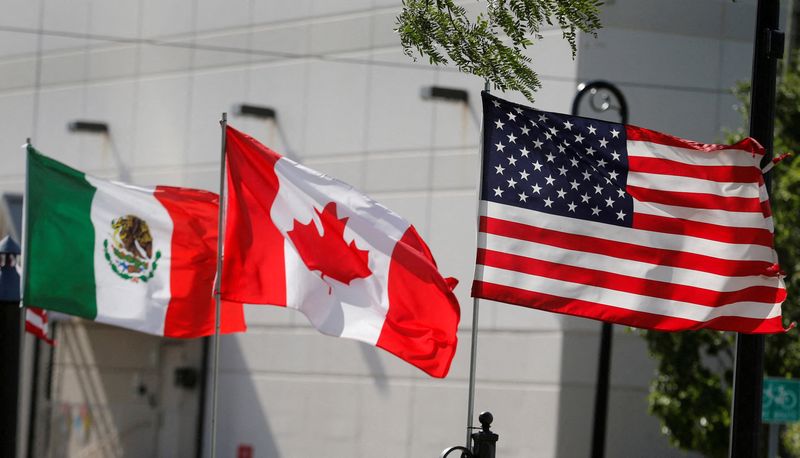
WASHINGTON, July 1 (Reuters) - Trade chiefs from the U.S., Mexico and Canada are due to review their trade agreement on Wednesday in an exercise expected to launch a decade-long sunset of the regional pact as they continue negotiations aimed at satisfying President Donald Trump's desire to shift more manufacturing to the U.S.
Trump's trade chief, Jamieson Greer, was meeting virtually with Mexican Economy Minister Marcelo Ebrard, and Canadian trade minister Dominic LeBlanc to declare whether they want to extend the U.S.-Mexico-Canada Agreement for another 16 years.
Mexican President Claudia Sheinbaum said on Tuesday that she wanted to extend the 32-year-old free trade zone for another 16 years, which would happen if all three countries agreed to extend it in its current form.
But Greer has already said that more time is needed to fix problems with USMCA and has scheduled another negotiating round with Mexico for the week of July 20. He has not begun formal negotiations with Canada on USMCA revisions.
Trump, who has imposed tariffs of 25% on Mexican and Canadian autos, 50% on metals and 10% on lumber, has repeatedly said that he does not want to extend USMCA, which he launched in 2020 as "the best agreement we've ever made."
In two rounds of negotiations with Mexico, Trump's administration has demanded that North American-built vehicles contain 50% U.S. content, pushing the regional total to 82%.
Denying a USMCA extension buys more time for negotiations but prolongs uncertainty over business investment decisions in the region, as the trade pact will be subject to annual reviews with a future in doubt.
Advertisement
U.S. auto industry officials are calling for a swift resolution that restores duty-free vehicle and parts trade between the U.S., Canada and Mexico. They argue that the current tariffs leave them at a disadvantage to automakers in Japan and South Korea, which face only a 15% tariff and no rules of origin, allowing widespread use of cheaper, subsidized parts from China.
U.S. Representative Rosa DeLauro said that she and many fellow Democrats want Trump to demand changes that help American workers, arguing that USMCA failed to stop the decline of U.S. factory jobs that started under its predecessor, the 1994 North American Free Trade Agreement.
"If President Trump does not commit to renegotiating USMCA in a bipartisan fashion to strengthen worker protections, American workers will continue to pay the price. This is not the time for half measures or extensions of the status quo," DeLauro said.
U.S. labor unions also have called for the review to prompt changes that will raise wages in Mexico and enforce labor and environmental rules.
"USMCA has so far failed to stop the race to the bottom on wages and working conditions across North America, as greedy corporations continue to shift production to Mexico," United Steelworkers President Roxanne Brown said in a statement.
But Lana Payne, national president of Unifor, Canada's biggest labor union, said that Canada needed to stand up for its rights against Trump's "Section 232" tariffs.
"Those tariffs are hurting workers and key industries like auto, steel, aluminum, and forestry," Payne said. "The reality is Canada has things the U.S. needs, including critical minerals, aluminum, potash, and energy to name a few. We need to stand firm, hold the line and use that strength to secure a fair deal for Canadian workers."
(Reporting by David Lawder; Additional reporting by Kalea Hall in Detroit and Promit Mukherjee in Ottawa; Editing by Andrea Ricci )
Source: “AOL Breaking”
